
FAFO Meaning in Text: What Does FAFO Mean 2026
FAFO stands for “f*** around and find out.” In text, it’s a blunt warning that if you provoke, ignore, or push someone, you should expect the consequences. You’ll see it in group chats, replies on social media, memes, and gaming lobbies, sometimes as a threat and sometimes as a joke.
What Does “FAFO” Meaning in Text?
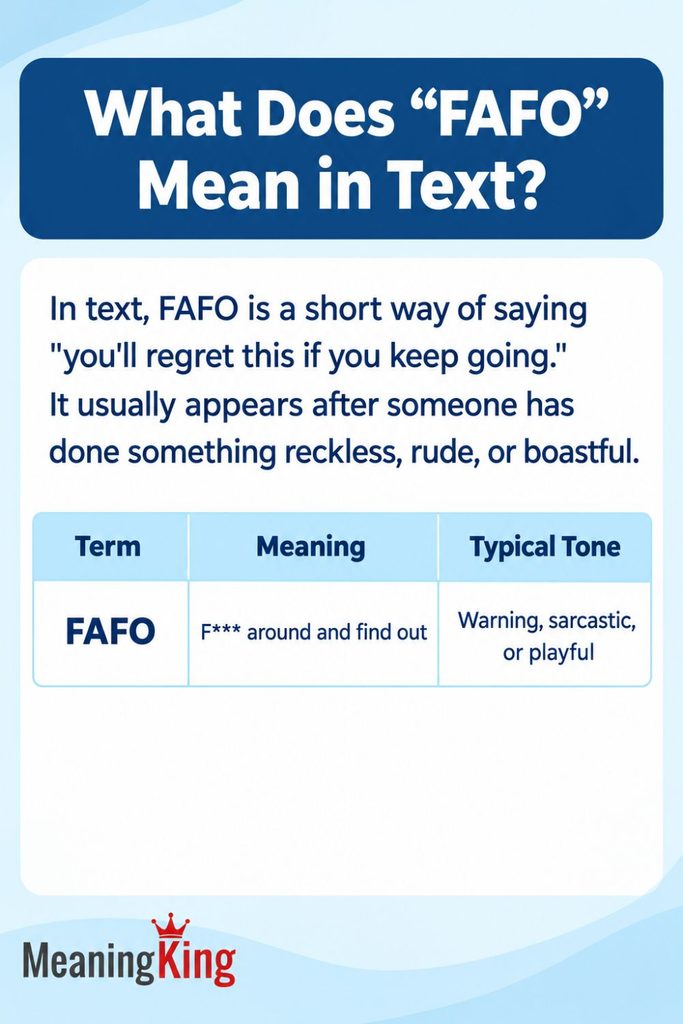
In text, FAFO is a short way of saying “you’ll regret this if you keep going.” It usually appears after someone has done something reckless, rude, or boastful.
The meaning stays the same, but the intent shifts:
- It can be a warning before something happens.
- It can be a reaction after someone faces the results of their own choices.
- It can be a joke between friends who both know it isn’t serious.
| Term | Meaning | Typical Tone |
| FAFO | F*** around and find out | Warning, sarcastic, or playful |
Can “FAFO” Be Used as a Verb?
Yes, informally. People treat FAFO like a verb or a general label for the cause-and-effect idea, even though it’s technically an acronym for a phrase.
Example:
“He tested the rules and got benched. Classic FAFO.”
“Don’t FAFO with my playlist.”
Some writers even say “FAFO-ing,” as in “they’re FAFO-ing right now.” This is casual internet grammar, so it fits chats and captions better than formal writing.
What Does “FAFO Moment” Mean?
A “FAFO moment” is the point where someone’s risky or disrespectful choice catches up with them. It describes the consequence itself, not the warning.
People use it for:
- A prank that backfires on the person who started it.
- A bold dare that ends badly.
- Someone ignoring clear advice and facing the result.
Example:
“He told the dog to try and take his sandwich. That was a full FAFO moment 😂”
The phrase is usually used about other people’s mishaps, often with a bit of dry humor.
The Most Common Meanings of “FAFO”
Most uses fall into four categories. The spelling never changes, but the intent does.
1. A Warning About Consequences
This is the most direct use. The sender is saying that continuing will lead to trouble.
Example:
“Keep poking the group chat and see. FAFO.”
It can sound firm or even threatening, depending on the relationship.
2. A Confident Challenge
Sometimes FAFO is a dare: go ahead and test me. It signals confidence rather than anger.
Example:
“Think you can beat my score? FAFO.”
Between friends or teammates, this reads as competitive banter.
3. A Meme or Joke
FAFO shows up in memes, captions, and reaction posts, often attached to a funny mishap. In these cases it isn’t aimed at anyone and is just a punchline.
Example:
“The cat knocked the glass off the table on purpose. FAFO energy 😂”
4. A Reaction to Karma
After the fact, people use FAFO to say “that’s what happens.” It can be sympathetic, sarcastic, or smug.
Example:
“Skipped studying, failed the quiz. FAFO, I guess.”
Here it works like an internet version of “you reap what you sow.”
How “FAFO” Is Used in Real Conversations
The same three letters sound different depending on where they appear.
Friends & Casual Texting
Among close friends, FAFO is usually teasing.
Example:
“Say that again and see. FAFO 😂”
The laughing emoji and the relationship make it clear nobody is angry.
Instagram & Snapchat
On IG and Snapchat, FAFO often appears in captions, Stories, and comment replies. It usually goes with videos of someone getting an unexpected comeuppance.
- Captions on clips of pranks or failed stunts.
- Replies to a friend’s risky Story.
- Short jokes added to memes.
Dating Apps
On dating apps, FAFO is riskier. A teasing line can come across as playful flirting with the right match, but it can also sound hostile or controlling to a stranger.
Example:
“Careful, I’m competitive at trivia. FAFO 😏”
This works when the tone is clearly light. Without emojis or rapport, many people would read it as aggressive.
Gaming & Online Communities
In gaming lobbies and Discord servers, FAFO is common trash talk. It usually follows a win or a mistake by an opponent.
- Teasing a teammate after a bad decision.
- Talking up a challenge before a match.
- Reacting to a rival’s loss.
Work or Professional Chat
At work, FAFO is usually a bad fit. It contains profanity in its full form and sounds confrontational. Even in casual team channels, most people avoid it unless the culture is very relaxed and everyone already uses internet slang.
Is “FAFO” Rude, Flirty, or Offensive?
It can be any of those. The word alone doesn’t decide it; context does.
When It Feels Neutral
When people use it to describe a situation, like a news story or a meme, it reads as commentary. Nobody is being targeted.
When It Feels Rude
It feels rude when it’s aimed directly at someone, especially during a disagreement.
Example:
“Keep talking and FAFO.”
When It Feels Flirty
In a teasing exchange between people who like each other, FAFO can be read as a playful dare. Emojis, humor, and an established rapport matter a lot here.
Context Changes Everything
Four things shape how FAFO lands:
- Relationship: friends versus strangers.
- Tone cues: emojis, punctuation, and surrounding words.
- Platform: gaming chat versus a work channel.
- Situation: a joke versus an argument.
How to Respond When Someone Says “FAFO”
Your reply depends on whether the message was a joke or a real warning.
Casual Replies
- “Haha okay, noted.”
- “Fair enough 😅”
- “Alright, I’ll behave.”
Funny Replies
- “Ready to find out, honestly.”
- “Bold of you to threaten me with consequences.”
- “Okay, but can I FAFO with snacks first?”
Neutral Replies
- “Understood.”
- “Got it, I’ll back off.”
- “Let’s keep it calm.”
Professional Replies
If the message was serious or hostile, keep it brief and steady:
- “I’d prefer to keep this conversation respectful.”
- “Let’s focus on solving the issue.”
- “If there’s a concern, I’m happy to talk it through.”
Common Misunderstandings About “FAFO”
Thinking It’s Always Aggressive
Many uses are jokes or reactions to memes. Treating every instance as a threat misses the humor.
Confusing It With Random Letters
Some people assume FAFO is a typo or a random string. It’s an established internet acronym, and the full phrase is what gives it meaning.
Misreading the Tone
Without voice or facial expression, text hides intent. A laughing emoji can flip the meaning, and its absence can make the same message feel colder.
Assuming Everyone Knows It
Not everyone is familiar with FAFO, especially people who are less active online. Using it with someone who doesn’t know the term can cause confusion or offense.
Similar Slang Terms You Should Know
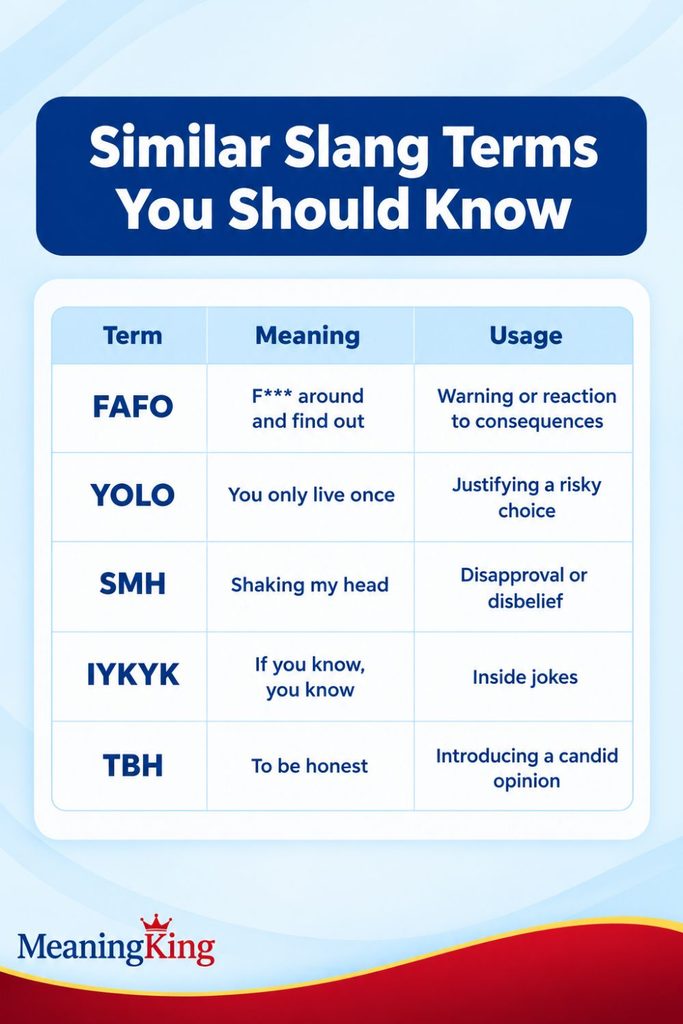
| Term | Meaning | Usage |
| FAFO | F*** around and find out | Warning or reaction to consequences |
| YOLO | You only live once | Justifying a risky choice |
| SMH | Shaking my head | Disapproval or disbelief |
| IYKYK | If you know, you know | Inside jokes |
| TBH | To be honest | Introducing a candid opinion |
FAFO is closest to sayings like “you asked for it” or “you made your bed.” Its main difference is the blunt, confrontational edge.
When You Should Avoid Using “FAFO”
Professional Settings
Avoid it in emails, meetings, and work chats. The profanity and confrontational tone can look unprofessional.
Cross-Cultural Conversations
Slang travels unevenly. People from other regions or languages may not recognize FAFO, and the profanity may land differently across cultures.
Sensitive Situations
Don’t use it when someone is upset, grieving, or dealing with a real mistake. A joke about consequences can feel cruel.
Public Arguments
In heated online arguments, FAFO can escalate things and may be read as a threat. Posting it publicly can also have consequences on some platforms.
Frequently Asked Questions
What does FAFO stand for in texting?
It stands for “f*** around and find out,” a warning that risky or disrespectful behavior has consequences.
Is FAFO considered rude?
It can be. It’s often blunt, and aimed at a person it can sound threatening. Among friends it’s usually joking.
Why is FAFO popular on social media?
It’s short, memorable, and fits memes and reaction posts about people facing the results of their actions.
Can FAFO be used as a joke?
Yes. Many uses are playful, especially with emojis or between friends.
Is FAFO appropriate at work?
Usually not. The profanity and confrontational tone don’t suit most professional settings.
Do younger people use FAFO more?
It’s common in online youth culture, but there’s no reliable data to say who uses it most, and people of many ages use it.
What is a simple way to explain FAFO?
“If you mess with the wrong thing, you’ll find out the hard way.”
Conclusion
FAFO is easy to understand but easy to misread. Pay attention to who’s speaking, where it appears, and what tone surrounds it. Used with the right audience it’s harmless; used in the wrong setting it can offend.

Hi, I’m a passionate language enthusiast and content writer dedicated to exploring the meanings and usage of words and names. With over 8 years of experience. I strive to make complex meanings simple and easy to understand. Through MeaningKing.com, I aim to be your trusted source for discovering the meaning behind every word.