
ION Meaning in Text: What Does ION Mean in Texting? 2026
ION is text slang for “I don’t,” used as a quick way to write “I don’t know,” “I don’t care,” or similar phrases without typing them out in full. It shows up constantly in DMs, comments, and group chats, and its tone shifts depending on what follows it and how it’s said.
What Does Ion Meaning in Text?
ION is a contraction of “I don’t,” created by blending the words together and dropping sounds the way people naturally do when speaking fast. It’s almost always lowercase and rarely stands alone, it’s paired with a verb like “know,” “care,” or “want” to complete the thought.
Quick Definition
ION = “I don’t,” used before a verb to form phrases like “ION know” or “ION care.”
Ion Most Common Meanings at a Glance
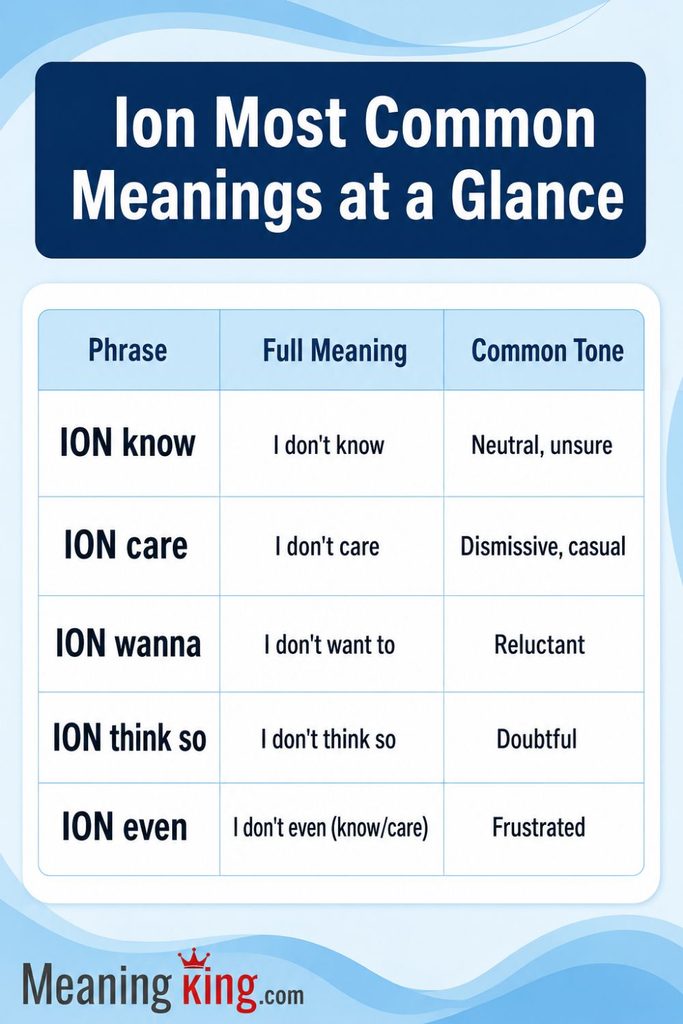
| Phrase | Full Meaning | Common Tone |
| ION know | I don’t know | Neutral, unsure |
| ION care | I don’t care | Dismissive, casual |
| ION wanna | I don’t want to | Reluctant |
| ION think so | I don’t think so | Doubtful |
| ION even | I don’t even (know/care) | Frustrated |
Ion Meaning — “I Don’t”
At its core, ION simply represents the phrase “I don’t.” It’s not an acronym, it’s a phonetic shortcut, similar to how “gonna” replaces “going to” or “wanna” replaces “want to.” When people type fast or speak the words aloud, “I don’t” naturally compresses into something that sounds like “ion.“
Where Did Ion Come From?
ION developed from casual spoken English rather than from any formal internet coinage. In everyday speech, especially in African American Vernacular English (AAVE) and Southern U.S. dialects, “I don’t” is frequently pronounced in a way that blends into a single syllable close to “ion.” ION is part of a broader pattern that includes similar spellings like:
- “finna” for “fixing to”
- “tryna” for “trying to”
- “imma” for “I’m going to”
The term gained wider visibility through TikTok, Twitter/X, and meme culture, where phonetic spellings spread quickly because they read as more casual and authentic than formal grammar.
How Is ION Used in Text Messages?
ION functions as a sentence starter or a mid-sentence phrase, almost always followed directly by a verb.
ION at the Beginning of a Sentence
When ION opens a message, it usually introduces the speaker’s opinion, feeling, or lack of knowledge about something.
Example:
“ION know what time the party starts.”
This usage sets up the rest of the sentence and reads as a natural, conversational opener.
ION Before Verbs and Phrases
ION almost always attaches directly to a verb to complete its meaning. Common combinations include:
- ION know
- ION care
- ION think
- ION want
- ION feel like
Example:
“ION feel like going out tonight.”
ION Meaning — “In Other News”
While “I don’t” is by far the most common meaning, ION occasionally stands for “In Other News” — typically used to shift topics in a conversation or caption.
Example:
“ION, I finally finished my project 🎉”
This meaning is far less common than “I don’t” and usually needs surrounding context to be clear, since the two meanings look identical in text. If a message doesn’t make sense as “I don’t,” it’s worth checking whether “In Other News” fits instead.
How Ion Is Used Across Platforms
ION appears most often in casual, fast-paced digital spaces rather than formal ones.
You’ll commonly see ION on:
- Instagram comments and DMs
- TikTok captions and comment sections
- Snapchat chats
- Twitter/X posts
- Group text messages between friends
Its use is generally consistent across platforms — the meaning doesn’t change based on where it’s posted, but shorter, punchier platforms like TikTok and Twitter/X tend to favor it because of their casual tone and character limits.
ION Texting Examples and Their Meanings
“Ion Know” Meaning
“Ion know” means “I don’t know.” It’s used to express uncertainty, indecision, or a lack of information.
Example:
“Ion know what to wear to the party.”
“Ion Care” Meaning
“Ion care” means “I don’t care.” Depending on tone, it can signal genuine indifference or mild annoyance.
Example:
“Do whatever you want, ion care.”
“Ion Wanna” and “Ion Want” Meaning
“Ion wanna” and “Ion want” both mean “I don’t want to” or “I don’t want.” They express reluctance or refusal.
Example:
“Ion wanna go to work today.”
“Ion Think So” Meaning
“Ion think so” means “I don’t think so,” used to express doubt or disagreement.
Example:
“Ion think so, that doesn’t sound right.”
Ion vs IDK What Is the Difference?
Both ION and IDK relate to uncertainty, but they aren’t identical in function.
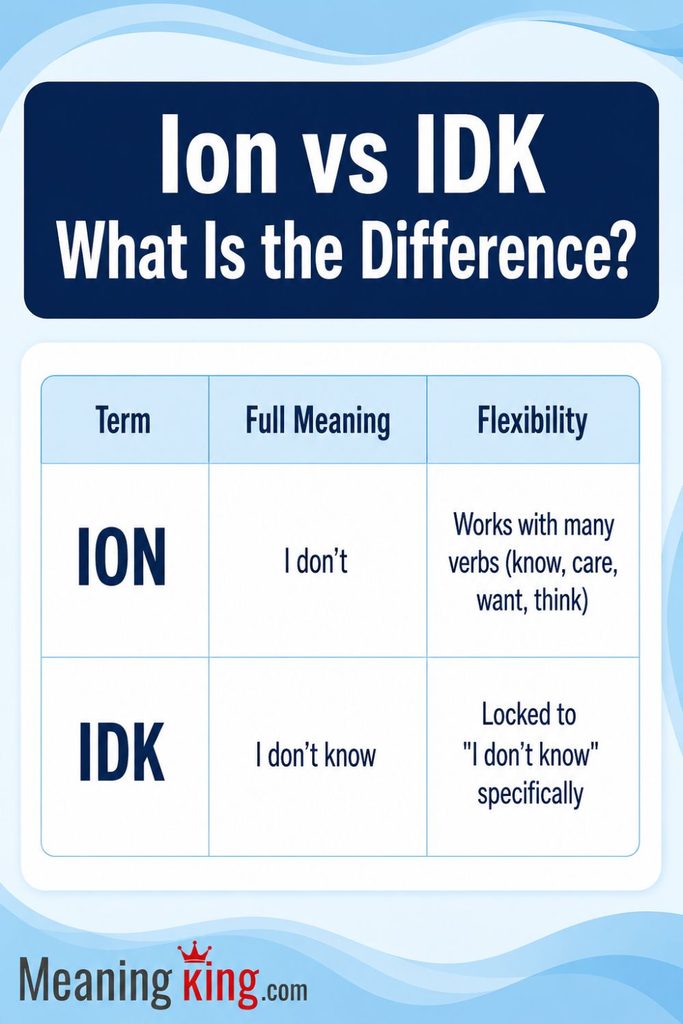
| Term | Full Meaning | Flexibility |
| ION | I don’t | Works with many verbs (know, care, want, think) |
| IDK | I don’t know | Locked to “I don’t know” specifically |
IDK is an acronym limited to expressing a lack of knowledge. ION is more flexible because it’s a phonetic contraction that can attach to almost any verb, making it usable in a wider range of sentences.
When to Use Ion — And When Not To
Use Ion When:
- Texting friends or peers casually
- Commenting on social media posts
- Writing in a tone that matches everyday spoken language
- The context is informal and relaxed
Never Use Ion In:
- Professional emails or workplace messages
- School or academic writing
- Formal documents or resumes
- Conversations with people who may not recognize internet slang
Frequently Asked Questions
What does ION mean in text?
ION means “I don’t” and is typically followed by a verb, as in “ION know” or “ION care.”
Is ION rude?
ION itself isn’t rude — its tone depends on the phrase and context. “ION care” can sound dismissive, while “ION know” is simply neutral.
What does ION stand for?
ION doesn’t stand for separate words like an acronym; it’s a phonetic spelling of “I don’t.”
Can ION mean something other than “I don’t”?
Yes, ION can occasionally mean “In Other News,” though this usage is far less common and depends on context.
Is ION appropriate for professional messages?
No, ION is casual internet slang and should be avoided in professional emails, workplace chats, or formal writing.
Is ION still commonly used in 2026?
Yes, ION remains a common texting shortcut, especially in casual conversations among younger users on platforms like TikTok, Instagram, and group texts.
Final Thoughts
ION is a simple, phonetic stand-in for “I don’t,” used to speed up casual texting rather than to convey a hidden or complicated meaning. Its tone shifts based on the verb that follows and the relationship between the people texting, so while it’s harmless in a group chat with friends, it’s best left out of formal writing.

Hi, I’m a passionate language enthusiast and content writer dedicated to exploring the meanings and usage of words and names. With over 8 years of experience. I strive to make complex meanings simple and easy to understand. Through MeaningKing.com, I aim to be your trusted source for discovering the meaning behind every word.
1 thought on “ION Meaning in Text: What Does ION Mean in Texting? 2026”