
JS Meaning in Text: What It Really Stands For and How to Reply
If someone ended a message with JS, they almost certainly meant “just saying.” People add it after an opinion, suggestion, or observation to make it sound lighter and less like a criticism. Whether it comes across as friendly, teasing, or a little sharp depends on the tone and the relationship behind the message. This guide covers what JS means in text, how it shows up on different apps, how to read its tone, its other meanings, and how to reply.
What Does JS Meaning in Text? The Quick Answer
Quick Definition
In texts and chats, JS stands for “just saying” (sometimes written “just sayin'”). The sender is signaling, “I’m sharing a thought, not starting a fight.”
You’ll usually see it after:
- Friendly advice
- An honest opinion the sender wants to keep light
- A playful tease
- A gentle hint or complaint
Because JS softens the message, the words before it matter more than the two letters themselves.
Where Did “Just Saying” Come From? The History Behind the Slang
The exact origin of stand-alone “just saying” is hard to pin down. The Oxford English Dictionary treats it as a clipped version of longer phrases such as “I was just saying.” Language writers have also noted similar constructions in older German and Irish English. Theories that it began with a sitcom or comedy routine are popular, but the trail is murky.
Why Do People Say “Just Saying”? The Psychology of Softening an Opinion
Softening an opinion is a very human habit. People use “just saying” for several reasons:
- To avoid sounding harsh or blunt.
- To skip an argument by framing the comment as a passing thought.
- To give advice without sounding bossy.
- To step back from a sharp remark. Cambridge Dictionary describes it as something said while criticizing, to make the criticism feel less offensive.
The same two letters can signal real tact or a convenient escape hatch. The rest of the message usually tells you which.
How People Use “JS” in Texts, DMs, and Social Media
Because JS is so short, it fits fast conversations well. People use it in:
- Private texts and SMS threads
- Direct messages (DMs) on social apps
- Comment sections and replies
- Group chats with friends, family, or coworkers
It almost always sits at the very end of a message, like a verbal shrug.
JS Meaning on Snapchat, TikTok, Instagram, and WhatsApp
The meaning stays the same everywhere. The style and audience change:
- Snapchat: Quick, casual, and usually lowercase, often paired with a joke or emoji.
- TikTok: Common in comments, where it softens a critique or a hot take.
- Instagram: Appears in DMs, story replies, and comments, often after a suggestion or a teasing remark.
- WhatsApp: Shows up in group chats and family threads, where it often reads as friendly advice.
No platform gives JS its own official meaning, so the surrounding conversation is your best guide.
Real Text Message Examples of JS in Context
Example:
“You’ve worn that jacket all winter, might be time for a new one 😂 JS“
Playful teasing between friends.
Example:
“You said you’d call last night. JS“
A pointed reminder. The writer is a little bothered but keeping it deniable.
Example:
“Take the earlier train, it’s packed after 6. JS“
Helpful advice with no edge.
The same abbreviation covers a joke, a complaint, and a tip. Tone and context do the real work.
Is JS Friendly, Sarcastic, or Passive-Aggressive? How to Read the Tone
JS isn’t rude by itself, but it can carry three main tones:
- Friendly: A tip or opinion offered in good faith, often with a smiley or “haha.”
- Sarcastic: An exaggerated or ironic remark, sometimes with 🙄.
- Passive-aggressive: A complaint or criticism made deniable by adding JS.
A quick test: remove JS and reread the message. If it no longer feels kind, the tag may be covering something sharper.
Lowercase, Uppercase, and Emoji: How Style Changes the Meaning of JS
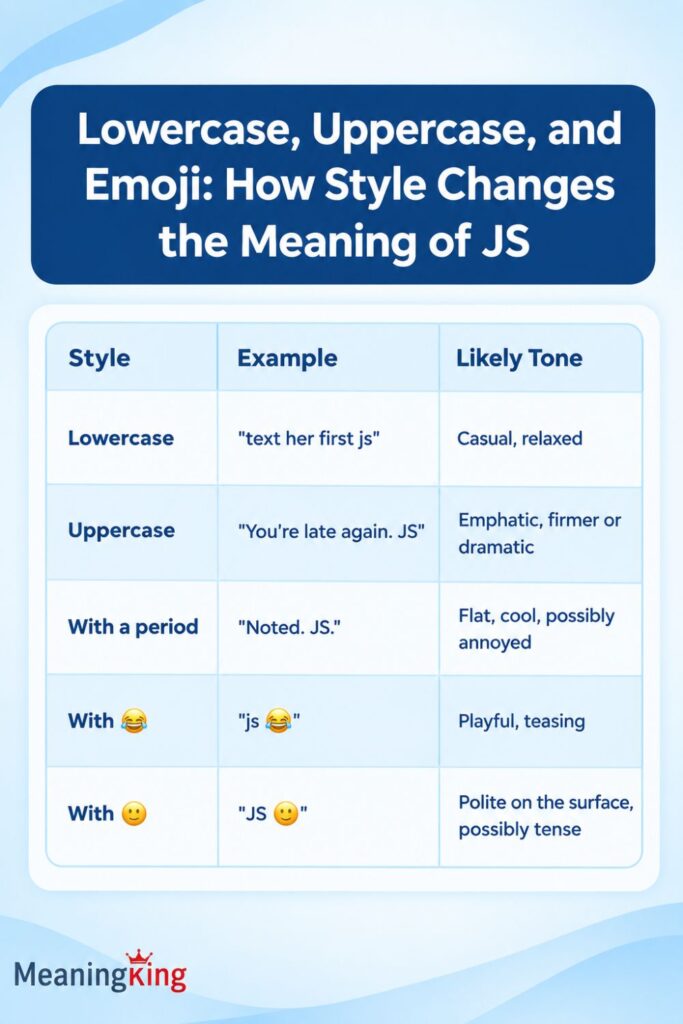
| Style | Example | Likely Tone |
| Lowercase | “text her first js“ | Casual, relaxed |
| Uppercase | “You’re late again. JS“ | Emphatic, firmer or dramatic |
| With a period | “Noted. JS.” | Flat, cool, possibly annoyed |
| With 😂 | “js 😂” | Playful, teasing |
| With 🙂 | “JS 🙂” | Polite on the surface, possibly tense |
These are tendencies, not rules, because people type differently.
What Does JS Mean From a Girl, a Guy, or Someone You’re Dating?
The sender’s gender doesn’t change what JS means. The relationship does:
- A friend: Usually honest advice or friendly teasing.
- Someone you’re dating: Often a soft hint or a mild complaint they don’t want to escalate.
- A crush or new match: Probably light banter, though the tone still matters.
- A coworker: Likely neutral. Keep your reply professional.
If a partner keeps adding JS after criticisms, a direct conversation will help more than decoding letters.
Other Meanings of JS: JavaScript, Initials, and More
Not every JS means “just saying.” Context decides:
- JavaScript: Common in coding and tech chats.
- Initials: A person’s first and last name, such as in a signature or contact label.
- Jumpscare: Some gamers use it this way in horror-game communities.
If the chat is about code, a project, or a named person, “just saying” is probably not what the sender meant.
JS vs. JK, TBH, IMO, and JSYK: What’s the Difference?
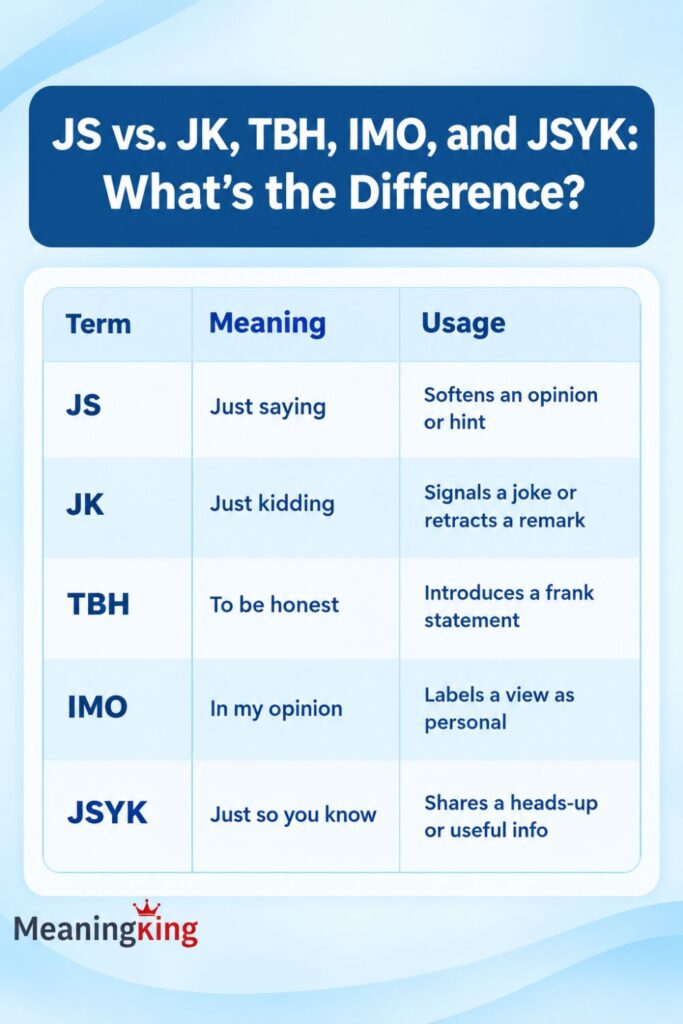
| Term | Meaning | Usage |
| JS | Just saying | Softens an opinion or hint |
| JK | Just kidding | Signals a joke or retracts a remark |
| TBH | To be honest | Introduces a frank statement |
| IMO | In my opinion | Labels a view as personal |
| JSYK | Just so you know | Shares a heads-up or useful info |
TBH and IMO usually come before an opinion, while JS usually comes after. JK takes a statement back, but JS stands by it gently.
How to Reply When Someone Texts You “JS”
Match your reply to how the message felt.
Friendly replies:
- “Fair point, thanks!”
- “Ha, good to know.”
Funny replies:
- “Noted, professor 😂”
- “Thanks for the honesty, I think?”
Direct replies (when it stung):
- “Was that a joke or a criticism?”
- “I’d rather hear it straight. What’s on your mind?”
Neutral replies:
- “Okay, thanks for telling me.”
- “Got it.”
Common Mistakes When Reading or Using JS in Chats
- Assuming JS is always harmless.
- Assuming it’s always an attack.
- Ignoring the earlier messages in the conversation.
- Confusing JS with JK.
- Using it to say something you wouldn’t say face to face.
Reading the whole conversation, not just the last two letters, avoids most of these errors.
When to Use JS in a Message and When to Skip It
JS works well when you’re:
- Sharing a friendly suggestion
- Adding a light opinion in a casual chat
- Teasing a close friend who knows your humor
Skip it when you’re:
- Writing work emails or formal messages
- Giving serious criticism
- Messaging someone who may be upset
- Talking to someone who may not recognize the abbreviation
If a comment matters, say it plainly and kindly instead of tacking on JS.
Do Different Generations Read JS the Same Way?
Not always, though this is a general observation, not research. Older readers often know the spoken phrase “just saying” but may stumble on the abbreviation or read it as initials. People who grew up with group chats will likely see it as ordinary shorthand. The tone gap is bigger than the meaning gap, since one reader hears a shrug and another hears a jab. With an older relative or someone new, writing out “just saying” is safer.
JS Meaning in Text FAQ: Quick Answers to Common Questions
| Question | Quick Answer |
| What does it mean? | Just saying |
| What tone does it carry? | Usually casual, sometimes pointed |
| How formal is it? | Informal only |
| What’s the best reply? | A light acknowledgment |
Frequently Asked Questions
What does JS stand for in text?
JS stands for “just saying.”
Is JS rude?
Not on its own. It can sound rude when it follows criticism.
What does JS mean in coding?
In tech chats, JS means JavaScript.
What is a good reply to JS?
“Fair point!” or “Thanks for telling me” works for most situations.
Final Thoughts
JS means “just saying,” and it’s designed to make an opinion, hint, or observation feel lighter. Its actual tone depends on the sender, the relationship, and the words around it. Read the full message before deciding how to take it, and reply in a way that fits.

Hi, I’m a passionate language enthusiast and content writer dedicated to exploring the meanings and usage of words and names. With over 8 years of experience. I strive to make complex meanings simple and easy to understand. Through MeaningKing.com, I aim to be your trusted source for discovering the meaning behind every word.
1 thought on “JS Meaning in Text: What It Really Stands For and How to Reply”